
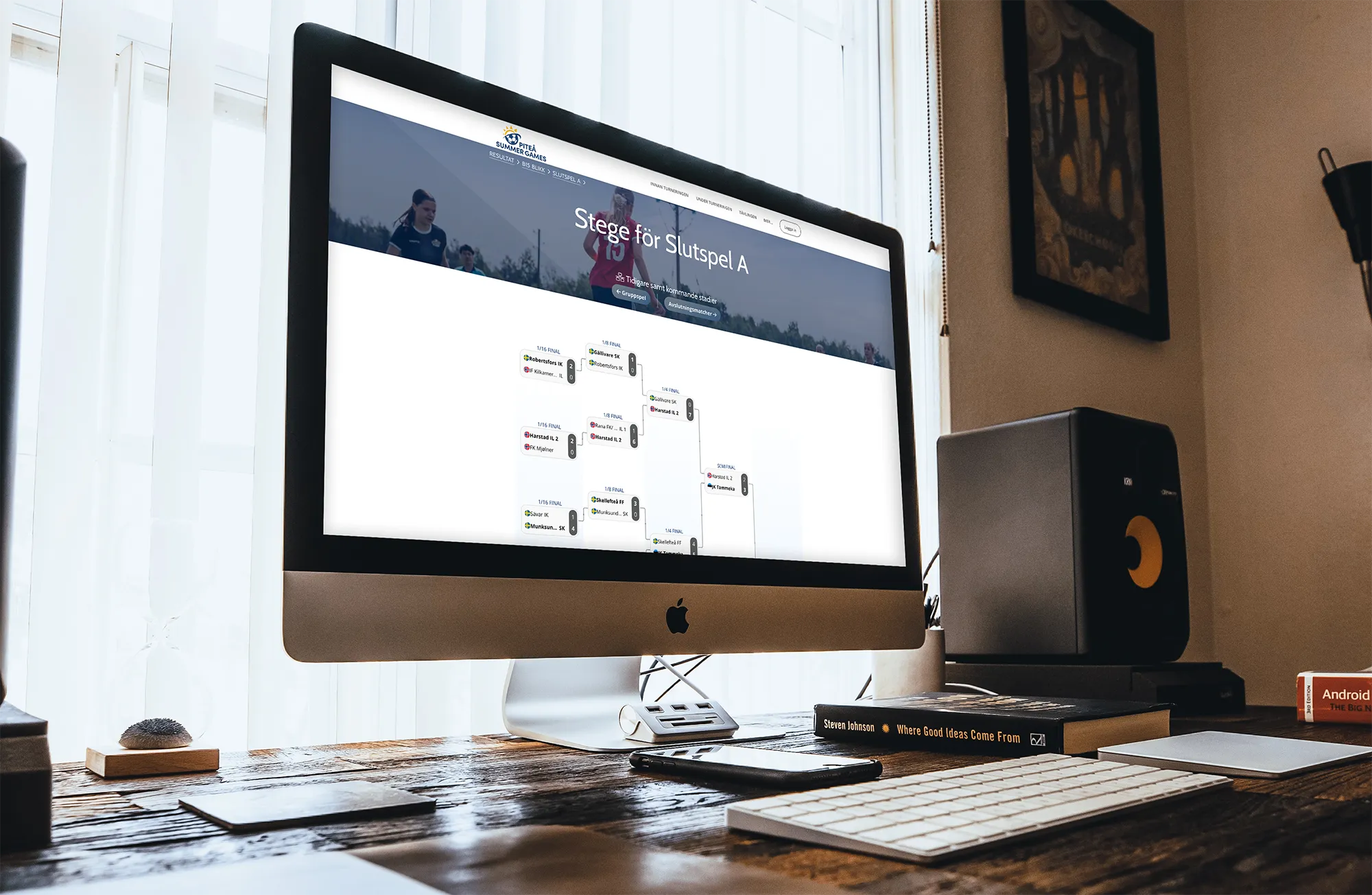
Draws and Scheduling
Cup Manager is built from the ground up to support you at every step as you put together your match schedule. Instead of relying on fixed templates, Cup Manager uses advanced algorithms for group allocation, team draws and scheduling alike. That's what lets us offer features that are genuinely automatic.
At the same time, we know that building a match schedule is complicated, even with automatic features to help. At every step you have to make decisions whose consequences aren't always easy to foresee. That's why we also think it's important to have clear overviews and support tools for checking, and manually fine-tuning, a finished schedule.
Finally, we know a system alone isn't everything you need. That's why we're always ready to answer questions and offer advice. It's always included in the license fee you pay, so don't hesitate to contact us. You can also find answers in our manuals.
Draw features
A complete overview of the draw
To always give you a clear overview of your tournament, the first thing you see in Cup Manager's draw feature is an overview screen covering all your age groups. From there you can easily see every group, playoff bracket and the connections between them. You'll also see if there are teams that haven't been drawn yet, or that are waiting on a reserve list.
Read more in our manual for more examples of what the overview shows.
A simple guide for automatic draws
Of course you can create every group in your draw manually and place the teams yourself, but Cup Manager also has a guide that helps you take advantage of all its automatic draw features. Choose whether the class should have results or not, which group sizes you prefer, and which teams advance to the playoffs, and Cup Manager generates a draw for you automatically. Want to make manual adjustments to a class afterwards? That's no problem at all! Read our manual for the draw guide here.
If you're curious, you can read more about what Cup Manager takes into account in our deep dive for tournament nerds.
Hidden matches
So you're not locked into the exact number of teams that have registered when you run a draw, Cup Manager has a concept we call hidden matches. It lets you set aside space in the draw for teams that don't exist yet (or that have withdrawn from the tournament). The matches that non-existent team would have played, both in the group stage and any playoffs, are then hidden from your visitors. They're still visible to you as an administrator, though, so you can schedule them and assign referees even before the team has registered, or while you're waiting for a replacement team to turn up.
Read more about hidden matches in our manual.
Even playoff brackets with Best Thirds
Cup Manager lets you build playoff brackets (or continuation groups) that, instead of pulling teams from fixed groups, rank teams across groups — for example ranking every group's third-place team so the best ones advance to the A playoffs. That way you can always make sure your A playoffs come out even. Naturally, the ranking is calculated completely automatically as you enter results in the group stage during the tournament.
Unlimited draw structures
Cup Manager has no limits on the number of teams, groups, playoffs, stages, classes, venues or matches when you build your schedule. Some combinations can certainly get complicated, but we support them anyway. Expect us to ask, with genuine curiosity, how you've thought things through if you do something in an unusual way. Maybe it's worth adopting ourselves!
Geographic grouping of teams
Of course teams from the same club shouldn't end up in the same group and be forced to play each other, but Cup Manager takes it several steps further: its algorithm for distributing teams also takes into account:
- City
- District
- Postal code
- Country
- Region
- Shirt color
That means you'll get balanced groups no matter what geographic area your tournament covers. If you're curious, we go into more detail on our deep dive for tournament nerds.
Automatic playoff brackets
Cup Manager doesn't use fixed templates to build a tournament's playoff brackets — instead, an advanced algorithm builds an optimal bracket no matter the circumstances. That means you don't need to worry about manually editing your brackets if you have a tricky mix of teams, for example ones that have advanced to your B playoffs, or if you have several uneven brackets.
If you have qualifying groups, Cup Manager automatically makes sure teams from the same original group meet as late as possible in the playoff brackets.
Read more on our page for tournament nerds if you're curious how it works.
Effortless color-coding
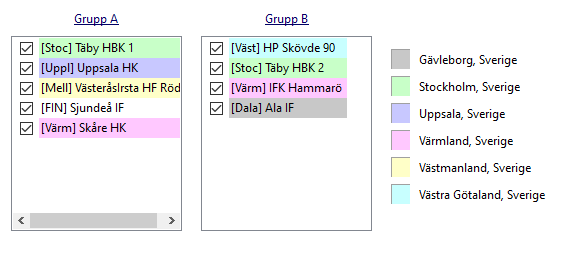
To easily see how teams from different countries or cities have been spread across the groups in your draw, you can choose to color-code the teams by various properties.
You can, for example, color-code by:
- Country
- Municipality
- Region
but also by other useful things, such as:
- Arrival day
- Meets in playoffs (shows teams from the same club that could end up meeting early in the playoffs)
Generate automatic qualifying groups
If your draw has a more complicated structure that includes qualifying groups and multiple playoff stages, Cup Manager can automatically help you create both the qualifying groups and the playoffs, making sure teams from the same group stage meet as late as possible in the playoffs — even when the path runs through qualifying groups. No more manual fiddling required.
Competitive classes without results
Cup Manager has advanced support for classes without results that goes far beyond simply hiding results on your website. We recommend two different approaches for a tournament with younger age groups that don't track results.
If you have the time for it (for example if you're playing over two days), you can build two consecutive group stages, where the second group stage brings together teams that are roughly evenly matched. By collecting results from the first group stage, Cup Manager can automatically sort teams into the second group stage without you needing to manually run a new draw before the tournament's second day. It also means Cup Manager can, right from the start of the tournament, show which matches a team is likely to play on day two, making it easier for participating teams to plan ahead. To avoid teams from the same club ending up in the same group on day two, you can use one of Cup Manager's color-coding views, which warns you if there's a risk of that happening.
The second option is to put all the teams in a class into a single group and let Cup Manager pick which matches should be played between them. By taking into account where the teams come from, Cup Manager can select matchups between teams that are as different as possible, to create as exciting a schedule as possible. This naturally also helps if you have slightly too few teams to form proper groups but still want everyone to play the same number of matches — for example just 7 teams, but everyone should play 5 matches.
Merge classes without affecting the registration form
If you have too few teams in a given age group, you can choose, when running the draw, to merge the teams from two classes into a single class in the draw. The merge only affects the draw, not the teams' registrations. That makes it easy to undo, and it also means you can keep registration open for both classes even after merging them, in case a few more teams show up and you want to split the classes again.
Manage reserve teams directly in the draw
While drawing an age group, you can keep track of the class's reserve list and any unapproved registrations right there in the draw interface. That makes it easy to move a team in from the reserve list if a gap opens up anywhere in the draw.
Scheduling
Graphical schedule
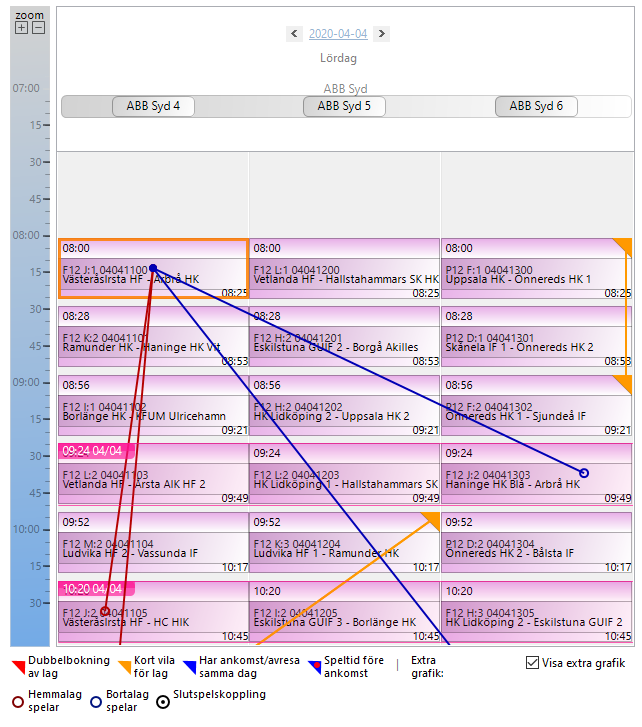
Just like with the draw, we believe a clear overview matters just as much for the tournament's schedule. That's why you can always pull up the entire tournament's match program as a graphical schedule showing every match. From there you can easily see the details of any individual match, and just as easily spot warnings and errors in the schedule thanks to the guide lines that are displayed.
If you like, you can group your pitches and get a schedule for each group of pitches. Cup Manager automatically offers groups by geographic area or pitch size (for example 7-a-side and 11-a-side) in football, but you can also create your own groups. For instance, all the pitches where finals are played, or split by weekend if you're playing across several weekends.
Hovering over a match instantly shows an info box with the match details, and you can also click it to, for example, find out where the home and away teams play all their matches. In the playoffs you naturally see the links to the previous and next match in the bracket.
Automatic scheduling to your own rules
Cup Manager has a built-in automatic scheduling feature. If you're curious how it works under the hood, there's more information here. The automatic scheduler takes rest times, arrival times and opening hours at your venues into account on its own, but on top of that there's a whole range of rules you can add to get exactly the schedule you want for your tournament. Are you playing over several days? Should everyone get at least one match on your main showcase pitch? Do you want a schedule with as little waiting time as possible for every team? Maybe a break should be longer so teams have time to grab a snack from your kiosk?
Even with an automatic feature for both draws and scheduling, there are still plenty of decisions to make. We believe a system isn't truly good until it's backed by great support. That's why we encourage all our customers to book a workshop with our skilled team, who can walk you through tips, tricks and all the smart features that are useful for your specific setup! Here you'll also find a manual covering the most common settings.
Takes arrival information into account
Cup Manager automatically takes into account the arrival information teams have added to their registration, if you've let them enter it. This applies both in the graphical schedule, which shows a warning if a team's first match falls before its arrival time, and in the automatic scheduling itself. That makes it easy to ensure participating teams don't get matches scheduled too early, and if that's unavoidable, you can quickly see which teams need to be contacted to see if there's another way to solve it.
Simple drag-and-drop for fine-tuning
Of course you can move matches directly in the schedule by dragging and dropping them to a new spot. While you're moving a match, the system also shows related matches and other important information, so you can easily find a slot where it fits.
Guide lines and warnings right in the schedule
If Cup Manager finds a problem with the schedule you've created, the warnings show up directly in the graphical schedule so you get an easy overview. Among other things, it flags double bookings, too-short rest times, and matches scheduled before a team's arrival time.
Clicking a match, or dragging it in the schedule, also helps you see every other match played by the teams involved, making it simple to check the length of breaks or find gaps in the schedule if you need to move the match manually.
Synced to your website, app and streaming
Every change you save is automatically synced across all your outward-facing information channels. That means you never need to worry about an outdated version of your match schedule sitting on your website or in your app.
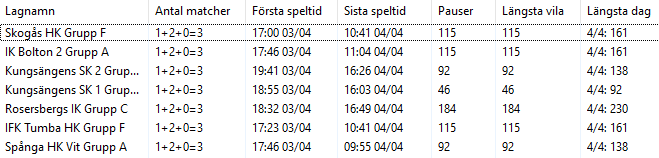
Overview of start, end and rest times for every team
Once you're happy with your schedule, you can open a table covering anything from individual groups to every team in the tournament, giving you a quick overview of the key figures. This lets you check that everyone has roughly the same number of long days and breaks, or plays the right number of matches on each day, if your tournament spans multiple days.
Publish individual days or classes only
If you only want to publish the match schedule for a single class, or maybe just the first day of the tournament, that's easy to control in Cup Manager. It lets you publish the first match for every participating team without the entire match schedule needing to be finished.
Read more about how publishing draws and match schedules works in this manual.

World-class support!
We know it's complicated to build both tournament plans and a great match schedule — especially under pressure as the tournament approaches and a few teams drop out at the last minute. We're used to that too, and we have plenty of experience solving the problems that come up in the best possible way.
That's why we always include full support in every license fee. We simply don't think you should be left alone in the boat. If you use Cup Manager, we solve the problems you run into together! So don't hesitate to contact support if you have questions — there's nothing we'd rather do!
Used for the world's biggest tournaments (and the smallest)
Cup Manager is used for everything from small 3v3 tournaments without results that just want to quickly put together a match schedule, to the world's biggest youth sports tournaments that, on top of every feature, need to keep a clear overview. We offer something for everyone, but above all you can trust us to make sure things work when it counts!

Together with our tournaments, our support team has built thousands of match schedules. We love sharing what we've learned along the way. Get in touch and we'll help you out!
Cup Manager support
Telefon: 046-52580E-post: support@cupmanager.net
Want a great schedule?
Get in touch with us, or pick a time to book a demo of Cup Manager. We look forward to showing you our system.
Pick a time for a demo